
The Independent Automotive Aftermarket Federation (IAAF) has published a new White Paper connecting its campaign for a statutory £54.85 minimum MOT fee directly to unlocking Particulate Number (PN) and NOx emissions testing in Great Britain.
The report, titled Squaring the Circle: Mandatory PN Testing in the EU Roadworthiness Regime, the UK MOT Position, and How a Minimum MOT Fee Could Unlock UK Adoption, argues that Department for Transport (DfT) hesitation around PN testing stems from implementation costs rather than technological viability.
By fixing a statutory minimum MOT fee at the current £54.85 cap, the IAAF says government can eliminate loss-leading £20 to £30 tests without increasing costs for motorists. This guaranteed return would give testing stations the financial confidence to invest in specialised PN counters and NOx measuring equipment.
Mark Field, Chief Executive of the IAAF, stressed that locking in the existing maximum fee resolves the funding bottleneck for advanced emissions equipment.
“Inflation alone would justify an MOT fee of around £95 today. We are not asking for that,” said Mark.
“We are asking for a floor at the price that has already been frozen since 2010, so that the garages carrying out these tests properly can afford the equipment they need.
“This isn’t about increasing costs for motorists; it’s about removing the only reason government itself has consistently given for delaying implementation.”
Modernising the diesel MOT inspection
The White Paper highlights critical shortcomings in the existing diesel MOT routine.
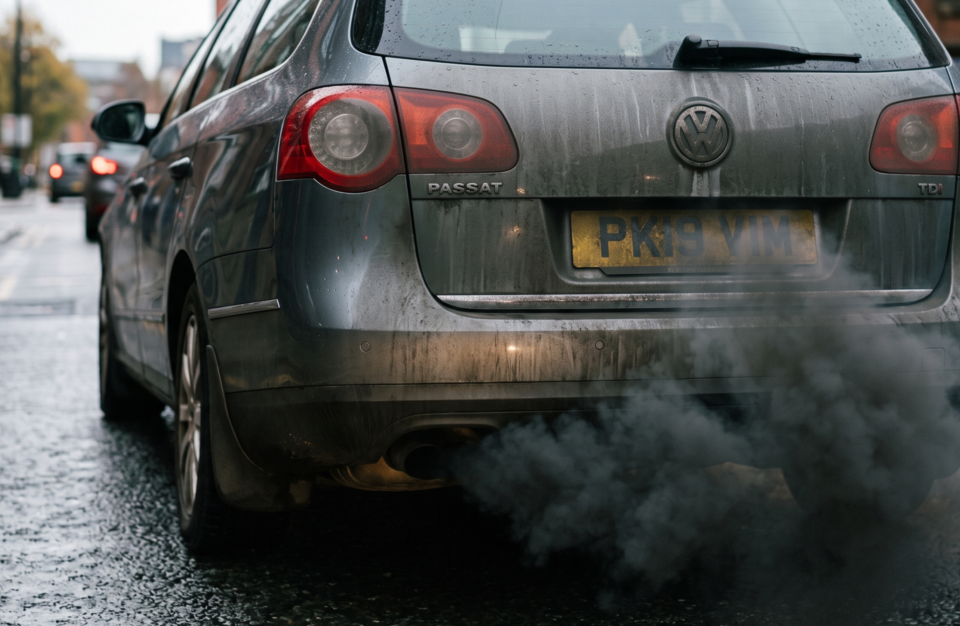
Traditional smoke opacity meters and visual checks routinely fail to catch software-based Diesel Particulate Filter (DPF) deletes or gutted housings that retain their external appearance.
IAAF research indicates a vehicle with a compromised or tampered DPF can emit particulate pollution equivalent to 10 to 20 compliant Euro 6 vehicles, with PN testing representing the only reliable diagnostic method to identify these failures during a routine inspection.
The federation also pointed to policy inconsistencies, contrasting Clean Air Zones and London’s ULEZ, where non-compliant drivers face daily charges of £12.50, with an MOT test regime that allows high-emitting tampered diesels to pass undetected.
IAAF recommendations to government
1. Firm Timeline: Commit to a clear implementation date for PN testing within the GB MOT framework.
2. EU Standardisation: Adopt European PN testing limits set at 250,000 particles/cm³ for Euro 5b (post-2013) diesel vehicles and newer.
3. Statutory floor: Fix the minimum MOT fee at the current £54.85 cap to ensure capital expenditure recovery without raising consumer price ceilings.
4. Implementation window: Maintain a two-year lead-in period to allow testing stations time to procure and install certified hardware.
5. UK alignment: Coordinate rollout plans with Northern Ireland to maintain a consistent national roadworthiness standard.
6. Phase two NOx: Commit to introducing NOx measurement as a second phase to tackle illegal AdBlue and Selective Catalytic Reduction (SCR) emulators.
“The evidence is settled and the public health case has already been made,” said Mark. “The only remaining barrier is funding.
“A statutory minimum MOT fee removes that obstacle without increasing the maximum price motorists pay, while giving garages the confidence to invest and helping government deliver cleaner air without further delay.”
5 comments
what a load of rubbish the fee must raise or its no longer viable at the current rate.
I’m afraid I have to take issue with Mark Field over the fee arrangement. A set minimum fee of £54.85 does not make commercial sense on a number of different levels. Firstly, why the .85p? it’s a rather silly amount. Secondly, this level of fee does NOT take into account the real world costs of running a modern MOT centre. I already charge £54 and am finding it increasingly difficult to justify existence. My hourly rate for mechanical work is £70ph so £54.85 for a qualified MOT tester is an insult. We are held to a very exacting standard by the ministry not only for the tests themselves but also all the equipment, the administration, the training and more besides. Ancillary costs such as computers, printers, internet access and phones plus a receptionist all add to the outgoing costs. Add to this, equipment failure/repairs plus the ever present calibration costs and £54 begins to look ridiculous.
An annual fee of £95.00 to ensure that a vehicle is roadworthy and safe is sensible, cost effective and means the we, as MOT stations, can run our businesses. Quite why there is a ‘fear’ of charging a reasonable fee I have no idea. Motor vehicles are most peoples daily life line on many different levels. Basically they are a tin can that travels at speeds up to 70mph and why any sane person would skimp is beyond me and to ‘justify’ a low fee only reinforces the perception that we, as garages and testing stations, don’t deserve proper recompense for keeping the motoring public safe. We already have to deal with cheap code readers that turn off vital warnings and compound issues so that eventual repairs are more costly than necessary.
So Mark Field, please lobby for a proper fee…!!!
I agree with David , there are so many costs involved in running a mot bay , we also have a shortage of testers , I would say mainly because they can earn more money elsewhere ,
As previously said driving into a city can cost £12.50 for a day there’s no correlation. A TV licence cost £180 a year , so been a professional in vehicle safety and helping to minimise the damage to our health and the environment is £54.85 . I agree it should be at least £75 to allow businesses to invest in equipment pay the staff a correct and valued wage and most definitely have annual increase so the situation of stagnant mot fee does not occur again .
If the fee is not changed, I will unfortunately be closing my Mot bay. Not longer financially viable. So much grief now compared to years ago, Fix price needed, no discounts. £95 is reasonable in this day and age. By Time I pay rent, rates, water, electric, Internet, Insurance, wages, Calibrations, replacing worn out equipment, Training, Etc Etc, It all adds up to more than the test fee.
Oh Yeah, Also, Why should a lorry test cost more. We are all doing the same jobs.
The government’s logic is that the MOT is a standardised compulsory product, so motorists should be protected by one predictable maximum. But that confuses the product being identical with the cost of producing it being identical.
Also, the flexibility operates in only one direction: a low-overhead garage may reflect its circumstances by charging £30, but a high-overhead or low-volume garage cannot reflect its circumstances by charging £70. That is economically distorted.
When a price ceiling is too low for a particular area, the cost does not magically disappear. Instead:
garages stop testing;
appointment availability falls;
waiting times increase;
repairs subsidise the MOT;
or testers are pressured to work faster.
A fairer system could allow regional bands, annual cost-based indexing, or unrestricted pricing with intervention only against genuine exploitation. Alternatively, if the government insists every motorist must receive the same nationally capped price, the government should subsidise garages where the actual delivery cost is higher.