

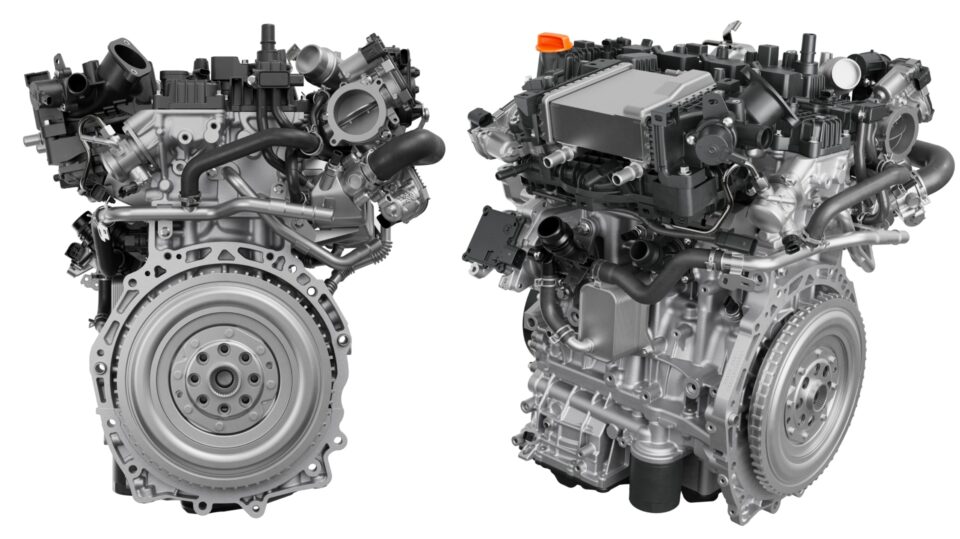
Powertrain manufacturer Horse, the global joint venture established by Renault Group and Geely, has revealed a fully waterproof 2.0-litre petrol engine designed to operate while fully submerged in up to 1.1 metres of water.
Designated the HORSE B20, the unit is engineered specifically for electrified drivetrains, supporting self-charging (HEV), plug-in (PHEV), and range-extended (REEV) configurations in commercial and 4×4 applications.
Weighing 130 kg, the turbocharged direct-injection four-cylinder develops between 140 kW and 185 kW (188–248 bhp) and 300 Nm to 380 Nm of torque.
It operates on an advanced Miller cycle, delivering a reported 48.4% brake thermal efficiency.
Submersible sealing and sensor logic
Achieving an IPX8 water-ingress rating required a wholesale rethink of engine bay architecture and sensor survivability.
The B20 uses a fully sealed physical casing, bespoke torsional vibration dampers, and dedicated high-integrity engine-to-transmission sealing interfaces to block moisture ingress under external hydrostatic pressure.
All peripheral electrical components and harness sensors carry independent IPX8 ratings, continuously monitoring external submersion.
When the engine control module detects deep water, it triggers dedicated control software that automatically modulates throttle profiles and derates peak engine output to maintain smooth combustion without hydraulicing or overwhelming the air induction path.
Mechanical and thermal architecture
Beyond water protection, the engine features several distinct mechanical configurations technicians will encounter across future European and global platforms:
Combustion efficiency: High-pressure direct injection pairs with high-tumble intake ports and shaped piston crowns designed around the “squish” effect, accelerating the flame front for lean, rapid burn cycles.
Structural casting: A gantry-type aluminium block incorporates an integrated exhaust manifold and simplified balance shafts to lower NVH while managing weight.
Lubrication and cooling circuits: A variable-displacement oil pump regulates lubrication under extreme chassis angles, including 100% (45-degree) grade climbs. Thermal loads are managed via a fully active dual-circuit cooling system to maintain tight temperature control under sustained off-road load.
“The HORSE B20 demonstrates how we are meeting the full range of market needs, delivering flexible engine and powertrain solutions designed for multiple use cases and applications,” said Ingo Scholten, Deputy Chief Technology Officer of Horse Powertrain. “Supporting HEV, PHEV and REEV platforms, the HORSE B20 enables new opportunities across a range of vehicle categories, particularly off-road applications, due to the engine’s waterproofing and climbing capabilities.”
First previewed at the Beijing Auto Show, the unit has entered early production in China aboard the Geely Galaxy Cruiser 700 PHEV, mated to a three-speed dedicated hybrid transmission (3DHT230).
As Horse supplies platforms across Renault, Dacia, Volvo, Nissan, and Geely, its underlying hybrid architecture offers an early technical look at how OEMs are engineering hybrid powertrains for extreme duty cycles.