

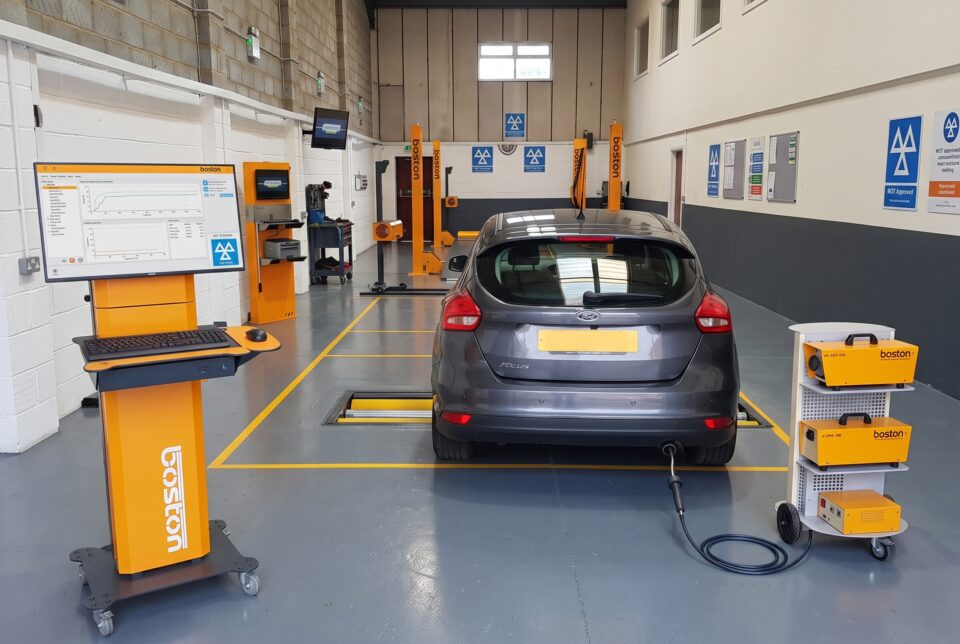
The Driver and Vehicle Standards Agency’s (DVSA) 2025 Market Surveillance Unit report exposes an uncomfortable operational reality for MOT testing: the technology modern vehicles use to control emissions has completely outpaced the test used to police them at annual inspection.
In surveillance testing, the DVSA deployed laboratory-grade Portable Emissions Measuring Systems (PEMS), climatic chassis dynamometers chilled to 0°C, and solid Particle Number (PN) counters capable of measuring down to 10.9 particles per kilometre.
Meanwhile, inside thousands of MOT test bays across the country, testers are still required to assess diesel emissions using a basic smoke opacity meter, a tool designed more than thirty years ago to catch heavy particulate plumes from mechanical rotary injection pumps.
This divergence carries immediate, practical implications for testing stations, garage owners, and technicians.
Why the opacity test is living on borrowed time
An opacity meter measures the light extinction coefficient of exhaust gas under a harsh, unloaded free-acceleration rev test.
A modern DPF with internal micro-cracks, thermal bypass channels, or a partially hollowed core can emit hundreds of times the permissible volume of microscopic, ultra-fine particulates. Yet under standard MOT smoke testing, it can easily register an opacity value of 0.00 to 0.05 m-1, scoring a clean, unquestioned pass.
Several European nations (including Germany, the Netherlands, Belgium, and Switzerland) have already mandated solid Particle Number (PN) counters for periodic technical inspection (PTI).
In those markets, the threshold is typically set around 250,000 particles per cubic centimetre.
Implementing this single test immediately caught an estimated 5% to 10% of modern diesels running with degraded or gutted filters that previous opacity tests had completely missed.
The DVSA’s own surveillance data proves that late-model Euro 6d cars maintain real-world particle counts well within statutory bounds when their aftertreatment remains intact.
When the agency itself relies on particle counts to evaluate vehicle integrity, retaining gross smoke opacity for statutory roadworthiness becomes technically indefensible.
The problem with testing cold vehicles
A key revelation from the 2025 surveillance programme is the significant spike in oxides of nitrogen and particulate matter when engines are run outside their primary thermal windows, specifically at low ambient temperatures and during short, low-speed urban cycles.
Manufacturers confirmed to the DVSA that Selective Catalytic Reduction (SCR) AdBlue dosing is actively restricted or delayed until exhaust gas reaches target light-off temperatures, while Exhaust Gas Recirculation (EGR) and injection timing are heavily modulated under cold-start conditions to protect engine components.
MOT testing problem
If periodic emissions testing eventually evolves to measure NOx or tailpipe particle counts under live running, vehicle conditioning becomes a minefield.
A customer presenting a diesel vehicle that has sat cold in an MOT holding yard for four hours on a freezing January morning will register a vastly different emissions fingerprint to one driven briskly for 20 miles down a dual carriageway.
Without tightly controlled pre-conditioning protocols, testing stations risk either unfairly failing vehicles running normal OEM warm-up protection routines or having to waste unbillable labour getting exhausts up to operating temperature.
Live OBD interrogation: the logical step
Because physical tailpipe testing of complex aftertreatment (SCR, lean NOx traps, active regeneration systems) under varied ambient temperatures is inherently difficult during a 45-minute bay slot, the surveillance paper adds momentum to expanding the role of on-board diagnostics (OBD) during the MOT test.
Current MOT visual inspection rules require a fail if the engine management malfunction indicator lamp (MIL) is illuminated, or if an emissions control system appears visibly modified or removed.
However, software calibrations and illicit “AdBlue-off” or “DPF-off” remaps frequently suppress the MIL and DTC reporting altogether, rendering visual and generic EOBD checks toothless.
To catch tampered or failing systems without laboratory-grade equipment, future MOT standards will need to scrutinise OBD readiness monitors, verify freeze-frame operational data, and interrogate live NOx and soot sensor telemetry against manufacturer plausibility thresholds.
Why it Matters
The trajectory outlined by the DVSA’s testing data points directly toward modernization of the test bay:
– Equipment investment will come: The transition from smoke opacity meters to solid Particle Number (PN) counters in UK test bays is a question of “when”, not “if”. As the UK vehicle parc transitions to an overwhelming majority of Euro 6 and Euro 7 platforms, the regulatory pressure on the Department for Transport to align with international PN standards will become unavoidable.
– The fee cap argument intensifies: Transitioning to PN counters and deeper digital diagnostic equipment demands significant capital investment and annual calibration costs. Trade bodies like the IAAF and IGA will use the DVSA’s own emissions findings to reinforce that the frozen £54.85 MOT fee cap is wholly incompatible with the advanced diagnostic equipment required to police modern exhaust systems properly.
– Diagnostics must lead the way: Technicians who master the thermodynamics of aftertreatment, understanding precisely when SCR dosing triggers, how thermal windows operate, and how to interrogate NOx sensor drift, will be the ones who successfully navigate both upcoming MOT regulatory reforms and everyday workshop fault diagnosis.
Should the MOT emissions test be overhauled with modern particle counters and live OBD checks, or does the system need a complete rethink first? Drop your views in the comments below.