

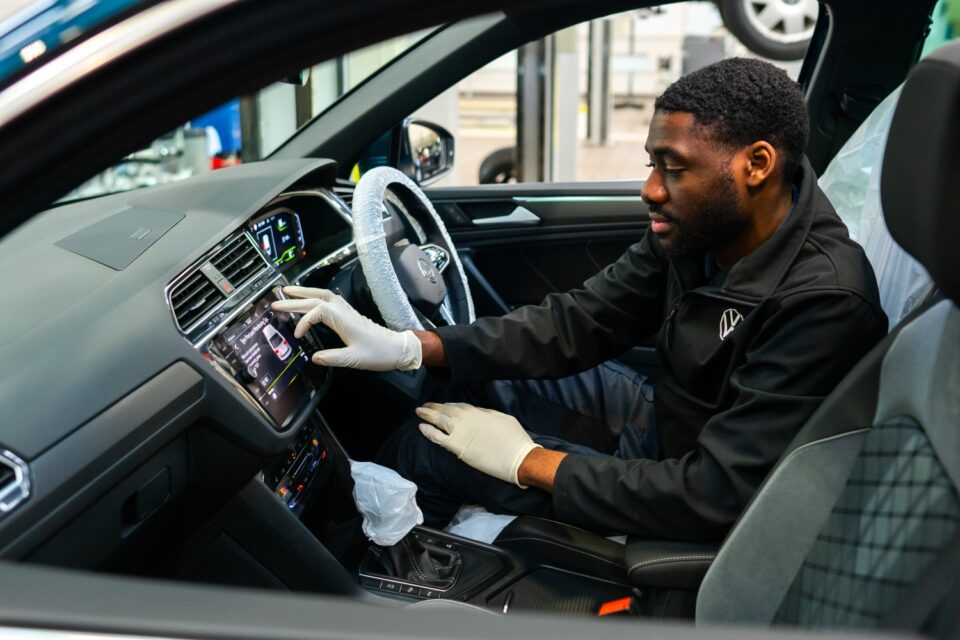
The Volkswagen Group has announced a major expansion of its vehicle data programme, which will see thousands of customer cars across the UK and Europe effectively acting as a roving research and development fleet.
Starting in January 2026, the manufacturer will begin harvesting “real-world” sensor and image data from customer vehicles in around 40 countries, including the UK.
The initiative marks a significant shift away from relying solely on factory prototypes for testing, with VW betting that data from the daily school run and supermarket trips will be more valuable for refining future driver assistance systems (ADAS).
The programme will launch first with Volkswagen Passenger Cars, followed by a phased rollout across other Group brands including Audi, Škoda, CUPRA, Volkswagen Commercial Vehicles, and Porsche.
Test mules
Historically, manufacturers have relied on small fleets of camouflaged “test mules” or computer simulations to validate safety systems.
This new initiative taps into “swarm data”, the collective mileage of thousands of ordinary drivers, to train the software behind automated driving functions.
According to Volkswagen, this data is already being used to generate high-resolution maps that allow vehicles to maintain lane guidance on roads where white lines are faded or missing, a common scenario on the UK’s crumbling road network.
By analysing millions of kilometres of real-world driving, engineers aim to make ADAS interventions smoother and less intrusive.
The goal is to reduce the number of drivers who switch safety systems off because they find them annoying or overly sensitive.
How it works
To address privacy concerns, the system does not transmit a continuous video feed. Instead, engineers have programmed specific “triggers” that prompt the vehicle to send a data packet back to HQ.
These triggers are activated during critical safety events such as emergency braking activation, manual full braking by the driver and sudden evasive steering manoeuvres.
In these instances, the car will transmit a snapshot of the environment including camera images, steering angle, speed, and weather conditions.
This allows Volkswagen engineers to analyse why a specific reaction was needed, for instance, determining if a pedestrian stepped out unexpectedly or if the car reacted to a false positive.
Volkswagen has stressed that the system is fully GDPR compliant and requires active customer consent, which can be managed via the vehicle’s user profile.
The rollout begins this month (January 2026) for Volkswagen models, with other brands following shortly after.
Why it Matters
This latest news further cements the vehicle’s role as a connected device. Volkswagen has confirmed that customers will benefit from improvements via Over-the-Air (OTA) software updates.
It places renewed emphasis on precise ADAS calibration, as “real-world” data collection relies on sensors being perfectly aligned to feed accurate information back to the manufacturer.