

The independent aftermarket is constantly urged to raise its standards, invest in training, and adhere strictly to the law. Yet, a quick glance at online marketplaces reveals a completely different reality where those rules simply do not seem to apply.
This week, the Independent Automotive Aftermarket Federation (IAAF) publicly called out a glaring loophole in online car parts retailing, pointing the finger directly at platforms like eBay and regulatory bodies like the Driver and Vehicle Standards Agency (DVSA).
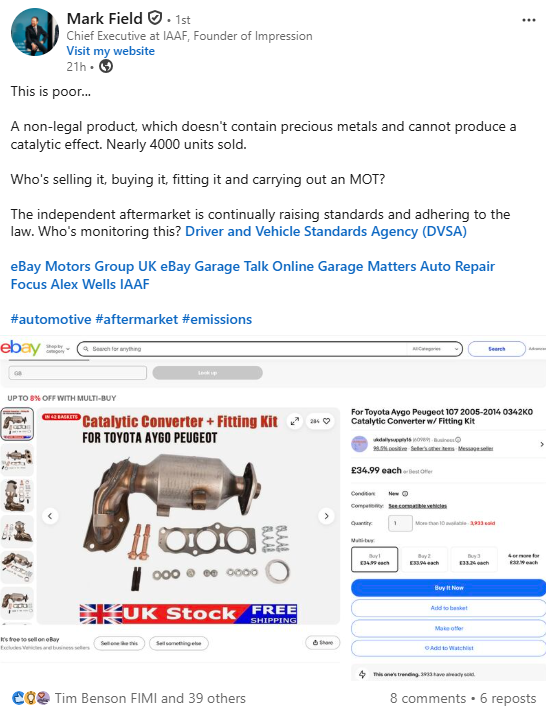
“This is poor,” wrote Mark Feild, Chief Executive of the Independent Automotive Aftermarket Federation (IAAF) on LinkedIn this week. “A non-legal product, which doesn’t contain precious metals and cannot produce a catalytic effect. Nearly 4000 units sold.
“Who’s selling it, buying it, fitting it and carrying out an MOT?”
The flashpoint is an eBay listing for a “Catalytic Converter + Fitting Kit” designed for a Toyota Aygo and Peugeot 107.
The price tag is a mere £34.99, and the seller prominently displays that nearly 4,000 units have been sold.
Why it Matters
A product at this price point cannot possibly be a legitimate catalytic converter.
Real catalytic converters rely on a ceramic core coated in Precious Group Metals, specifically platinum, palladium, and rhodium, to chemically convert harmful exhaust gases.
Given the current market value of these materials, a £35 retail price guarantees this unit is devoid of them, meaning it cannot produce a catalytic effect and is entirely non-legal.
The IAAF leadership has rightly asked the vital questions we should all be demanding answers to regarding these components: Who is selling it, buying it, fitting it, and carrying out an MOT?
Online e-commerce platforms need to take responsibility for this growing issue. Legitimate aftermarket suppliers operate on these sites but are constantly undercut by accounts shifting non-compliant components. Permitting the sale of these dummy components completely undermines the legal supply chain.
The sheer volume of sales suggests that DIY mechanics and motorists looking to save money are snatching these up.
However, it also puts legitimate workshops directly in the firing line. Front-of-house staff are increasingly being asked to fit cheap, customer-supplied parts like this and are forced to have the difficult, frustrating conversation about why they cannot, and legally will not, fit them.
Perhaps most alarming is the implication for the MOT test. If vehicles equipped with these hollow pipes are consistently passing their annual emissions tests, it points to a severe failure in testing procedures, faulty emissions equipment, or fraudulent activity at the testing station.

3 comments
It states “A non-legal product, which doesn’t contain precious metals and cannot produce a catalytic effect. Nearly 4000 units sold.” however it does provide any evidence. Were these products purchased, and tested. Were they cut open and examined? Is this a single manufacturer and supplier or are there more. At least show some evidence instead on banging own drum for members without any factual reporting.
If you take a look at the reviews for “That Item” a lot of them mention a TV bracket. It would seem the seller has repurposed an older listing into one for a catalytic converter. This would then mean the 4K+ sold number is not entirely honest.
Dont knock it till youve tested it, it may well be no good but without a proper test you cant condem them. I have been amazed at the high quality and low price of some Chinese components. Plenty of major car brands buy in their components from China for peanuts and then put a 500% markup on them.