

Most garage owners look to local colleges or school leavers when recruiting apprentices. But new data suggests parents are forming career opinions almost a decade earlier.
Ask any independent workshop owner what keeps them awake at night, and recruitment will invariably sit near the top of the list. Between an ageing workforce and the rapid influx of high-voltage powertrains, the scramble for fresh technical talent has never been more pressing.
Yet the traditional approach to attracting that talent, waiting until teenagers reach Year 10 or 11 to visit career fairs, may already be too late.
According to new research commissioned by BMW Group UK, which surveyed 2,500 UK parents, a significant generational shift has occurred in how families approach the world of work.
Among parents actively thinking about their child’s career path, nearly six in ten (58%) now begin doing so during primary school between the ages of four and 11.
Even more striking: the single most common window for parents to start weighing future career paths is ages four to six (30%) — when children are barely out of Reception and Year 1.
By contrast, half of parents whose children are now young adults (ages 19–24) admitted they waited until their child was 15 to 18 before considering career routes, with nearly two-fifths (38%) acknowledging they wished they had started far earlier.
These figures offer a critical insight. By the time prospective apprentices pick up their GCSE options, parental perceptions are largely set.
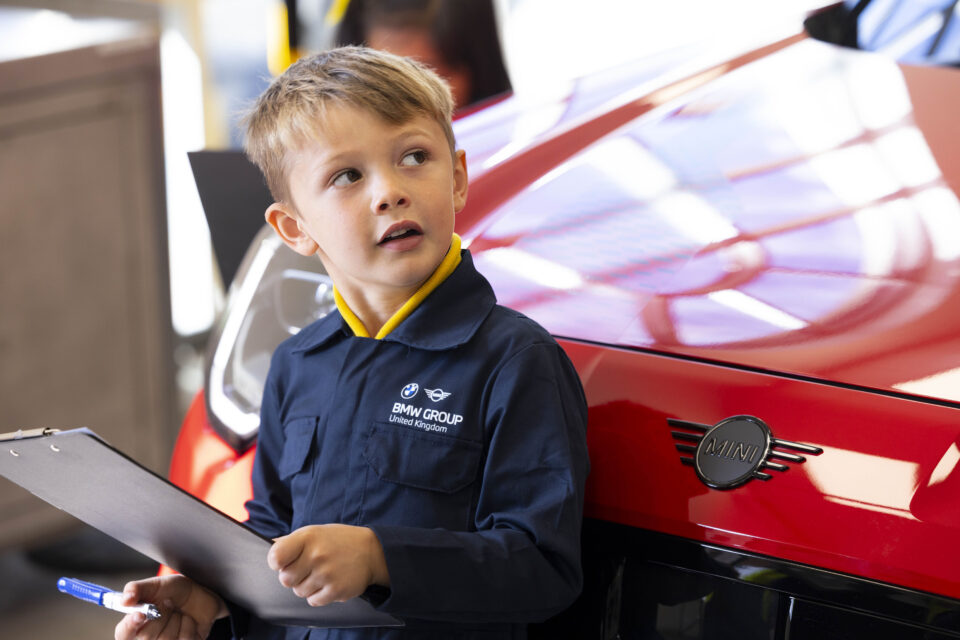
The OEM findings arrived alongside the manufacturer’s Apprentice 2036 launch and The Spark Lab, an EV engineering workshop designed specifically for five- and six-year-olds.
Pupils explore battery modules, charging infrastructure, and EV architectures, using the technology under vehicle bonnets to build enthusiasm around STEM subjects from the very start of primary education.
While an OEM has the resource to run dedicated academy programmes, the underlying principle is one independent garages can no longer afford to ignore.
The aftermarket continues to battle outdated public misconceptions of vehicle repair.
Too many parents still envision cold, greasy workshop floors rather than diagnostic scopes, high-voltage isolations, and software calibrations.
Parents want alternatives to university
The research shows that parents are hungry for practical, technical alternatives to university, yet feel unprepared for what the future workplace requires:
– 76% of parents believe primary school pupils need more opportunities to experience real-world engineering and practical technology.
– 78% believe AI and automation will drastically reshape future job availability.
– 49% admit they do not know what specific skills their children will need to succeed.
– 39% want their child to consider an apprenticeship after secondary education, positioning vocational routes ahead of traditional full-time employment (35%) and closely trailing university (48%).
With tuition fees rising and graduates facing intense debt, the appeal of an apprenticeship, earning a wage from day one while mastering advanced diagnostic and mechanical problem-solving, has never been higher among parents. What is missing is visibility.
If modern independent businesses want to secure the diagnostic technicians of 2036, community engagement needs to start earlier and closer to home.
Winning over the next generation
Workshops do not need an OEM budget to change how local families view modern motor vehicle repair:
– Open the doors to local schools: Hosting a short “how cars work” morning, showing children diagnostic tablets, camera alignments, or the inner workings of hybrid systems, demonstrates that today’s vehicle technician is effectively a software-literate systems engineer.
– Target parents directly: Parents drive early career attitudes. Garages that actively showcase their investment in tooling, EV training, and clean workshop environments on social media and customer newsletters help dismantle legacy trade stereotypes right in their local communities.
– Sell the career, not just the job: For school leavers and parents weighing career stability against technological disruption, vehicle maintenance remains a resilient, highly skilled, and non-outsourceable profession. Highlighting clear career progression, from apprentice to diagnostic master technician or workshop manager, shows families that the independent sector offers a genuine, lucrative career ladder.
Is primary school too early to spark an interest in workshop careers, or is the aftermarket missing a trick by waiting until GCSEs? Have you ever engaged with local schools or taken on an apprentice who showed an early spark for the trade? Share your thoughts and experiences in the comments below.