

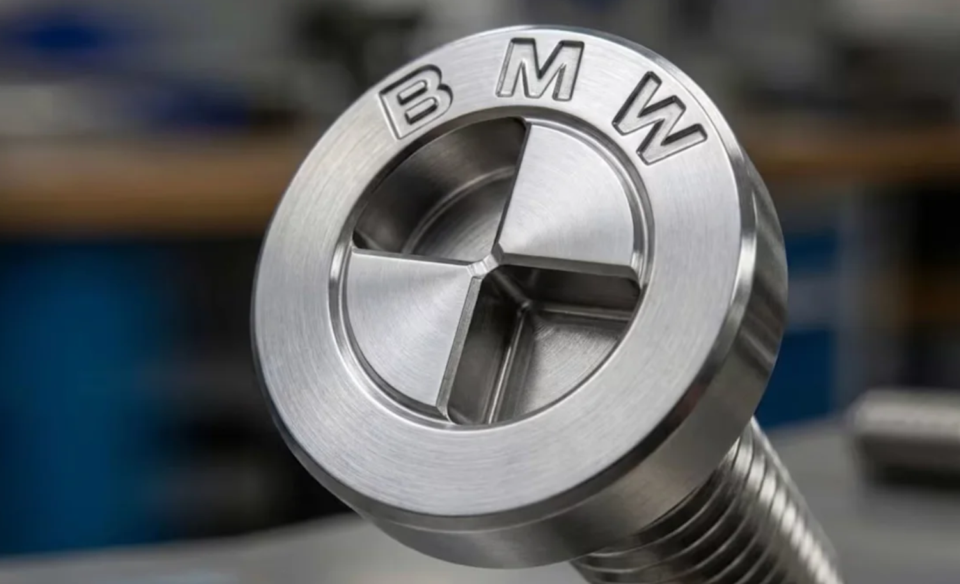
Rumours circulating across workshop floors, tech forums, and industry trade groups over a potential hardware lockout on future BMW models have been officially put to rest.
Following widespread speculation sparked by late-2025 patent filings depicting a proprietary, roundel-shaped fastener design, BMW UK has confirmed it has no plans to introduce such a bolt into production vehicles.
The controversy began when patent documentation surfaced from the World Intellectual Property Organization (WIPO) revealing a novel screwhead design engineered around BMW’s famous four-quadrant emblem.
The patent detailed a head where two opposing quadrants formed recesses to accept a matching custom driver bit, while the remaining two quadrants sat completely flush. Designed for high-torque structural and semi-structural applications, such as interior-to-body tie-ins and seat mountings, the configuration meant standard Torx, hex, or socket tools would simply spin without engaging.
What caught the attention of the wider trade was the explicit wording within the patent draft itself, which cited “preventing loosening or tightening with common tools by unauthorised persons” as a primary design objective.
Automotive media outlets, including Autoblog, picked up on the story late last year, raising fears that routine interior work or mechanical teardowns on future architectures could be locked behind dealer-only tooling hardware.
Legal context
To understand why this patent caused such an uproar, and why that uproar was ultimately unfounded, it helps to look at the gap between standard patent terminology and real-world compliance.
In the world of intellectual property, phrasing like “preventing access by unauthorised persons” is standard boilerplate legalese.
Patent attorneys write descriptions using the broadest possible restrictive language to define an invention’s novelty and defend against design infringement.
In engineering terms, “unauthorised persons” generally refers to untrained vehicle owners or third parties attempting to tamper with safety-critical assemblies (such as seat anchors calibrated for precise clamp load), rather than a targeted conspiracy against independent workshops.
More importantly, even if BMW had brought this fastener head to a production assembly line, a patent cannot overrule competitive law.
Under Motor Vehicle Block Exemption Regulations (MVBER), vehicle manufacturers are legally prohibited from creating proprietary hardware “blackouts”.
If a vehicle manufacturer introduces a unique drive profile, much like historical shifts to Torx, Torx Plus, or Five-Lobe security bits, they are legally obligated under MVBER to provide non-discriminatory access to the matching service tools, or license the driver geometry so aftermarket manufacturers can supply the trade.
A unique bolt head creates a brief tooling requirement, not a permanent repair lockout.
BMW clarifies position
Clarification came after fleet software and service network specialist Fleet Assist directly approached BMW UK to address the growing speculation among garages and fleet operators.
BMW UK issued a statement squashing rumours of an impending hardware hurdle: “Whilst there appears to have been discussion online regarding a patent filing, BMW UK is not aware of any plans to introduce such a specialist bolt.
“It is also worth noting that Block Exemption regulations are designed to ensure that vehicle manufacturers cannot prevent independent operators from accessing the information, tools and resources required to carry out servicing, maintenance and repair activities.
“As such, any suggestion that BMW would seek to restrict access to SMR through the use of proprietary fixings should be viewed carefully.”
Under UK MVBER frameworks, vehicle manufacturers are required to ensure independent repairers can access necessary technical information, diagnostic software, and essential servicing tools.
Attempting to restrict routine Service, Maintenance, and Repair (SMR) tasks behind an exclusive, unsourceable hardware fastener would trigger immediate regulatory enforcement across UK and European markets.
Commenting on the response, Nikos Kotrozos, Supply Chain Director at Fleet Assist, highlighted the importance of challenging repair-restriction narratives before they cause market uncertainty: “As this fake publicity was building momentum, we felt responsible to bring it to the attention of BMW UK to give them an opportunity to refute it.
“We are very pleased it has been responded to with the professionalism associated with the global brand.
“It is also important for our garage network customers and suppliers to make sure that Block Exemption regulations apply, and relevant vehicles can continue to be maintained in congruence with their elected work direction policies both at franchised and independent garages accordingly.”
While digital access, pass-thru programming, and gateway security remain active focus areas for Right to Repair advocacy, hardware access under MVBER remains protected.