

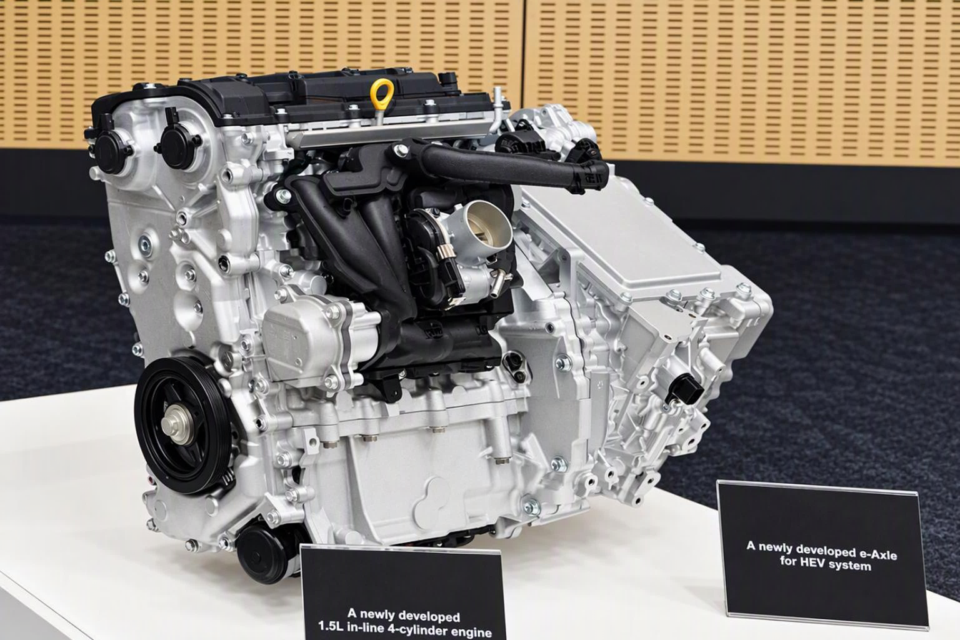
Toyota has revealed details of an all-new, ground-up hybrid powertrain built around a modular 1.5-litre four-cylinder petrol engine.
Targeting a 15% leap in fuel efficiency and engineered to slot directly into shared EV chassis architectures, the announcement sends a loud message to independent workshops: the internal combustion engine is far from dead, but the hardware arriving on your ramps is about to get substantially more compact and technically complex.
Rather than converting an existing ICE block for electrification, Toyota developed the combustion unit, electric motors, power control unit (PCU), and silicon carbide (SiC) inverters concurrently as a single, tightly packaged powertrain.
Available in naturally aspirated and turbocharged guises, the new naturally aspirated four-cylinder will eventually replace both the long-running 1.8-litre engine and the current 1.5-litre three-cylinder.
For technicians, this is the architecture destined to drive Toyota’s core European volume—and the cars that will fill independent bays once dealer warranties expire.
Tighter Bays, Shared Platforms
From an engineering standpoint, the headline is size. Toyota has reduced the overall physical footprint and height of the engine and hybrid transaxle assembly.
This design allows the complete combustion and hybrid setup to fit into a common “multi-pathway” platform designed primarily around battery-electric vehicles (BEVs).
While lower packaging allows vehicle stylists to drop bonnet lines and cut aerodynamic drag, technicians will recognise the immediate practical consequence: engine bay packaging will become significantly more congested.
Ancillaries, thermal management valves, wiring looms, and high-voltage cabling will be packed into tight envelopes, making routine access, component replacement, and belt/chain maintenance more demanding on book times.
Silicon Carbide and Multi-Loop Cooling
To extract an extra 15% in efficiency, Toyota is focusing on reduced mechanical friction, smaller electrical losses, and sophisticated thermal management:
Silicon Carbide (SiC) Power Electronics: Toyota has integrated in-house-developed SiC semiconductors into the inverters.
Switching faster and running hotter with lower energy loss than traditional silicon, these units demand precise high-voltage diagnostic routines.
For technicians, diagnosing hybrid drive faults will increasingly rely on live-data evaluation and high-speed scope analysis rather than straightforward trouble-code reading.
Complex Thermal Management: Squeezing efficiency from both the ICE and HV electronics means sophisticated, multi-circuit cooling systems.
Workshops will need dedicated vacuum-filling equipment and scan-tool-driven electronic bleeding procedures to prevent air pockets from cooking delicate inverter packs or cylinder heads.
A Shared Future Across Marques
Independent garage owners should also note Toyota’s explicit strategy to increase third-party sales of its engine and hybrid assemblies.
Just as workshops regularly encounter BMW-sourced units in Toyotas or Renault-Nissan hardware under Mercedes bonnets, this next-gen 1.5-litre system is engineered to be licensed to external vehicle manufacturers.
Combined with Toyota’s focus on ensuring the new engine family can run on carbon-neutral and renewable e-fuels, combustion-hybrid technology is clearly being cemented for the long haul.