

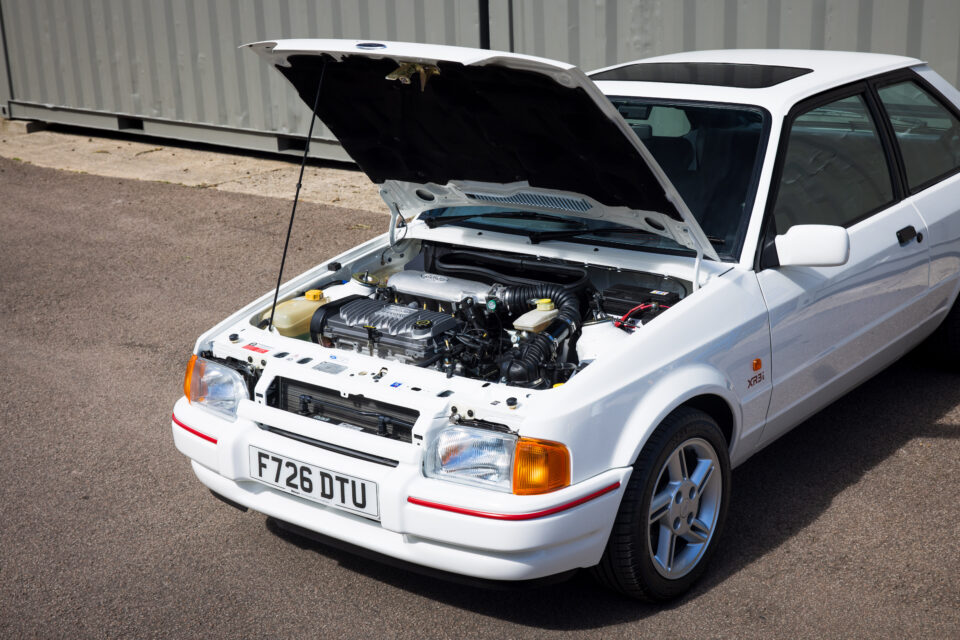
For any tech who has ever skinned a knuckle working on ’80s Blue Oval fastbacks, the Ford Escort XR3i evokes a very specific mix of nostalgia and mechanical frustration. It was an era-defining hot hatch, but it was also a vehicle plagued by severe corrosion and an underwhelming, often harsh CVH powertrain.
When Warwickshire-based specialist Tolman Engineering accepted a bespoke commission to build a one-off “Tolman Edition” XR3i, they chose a path that completely rejects the modern trend of dropping a generic crate engine into an old shell.
Instead, the firm invested 1,600 hours into retaining the car’s original DNA while systematically re-engineering out the factory flaws that contemporary road testers rued.
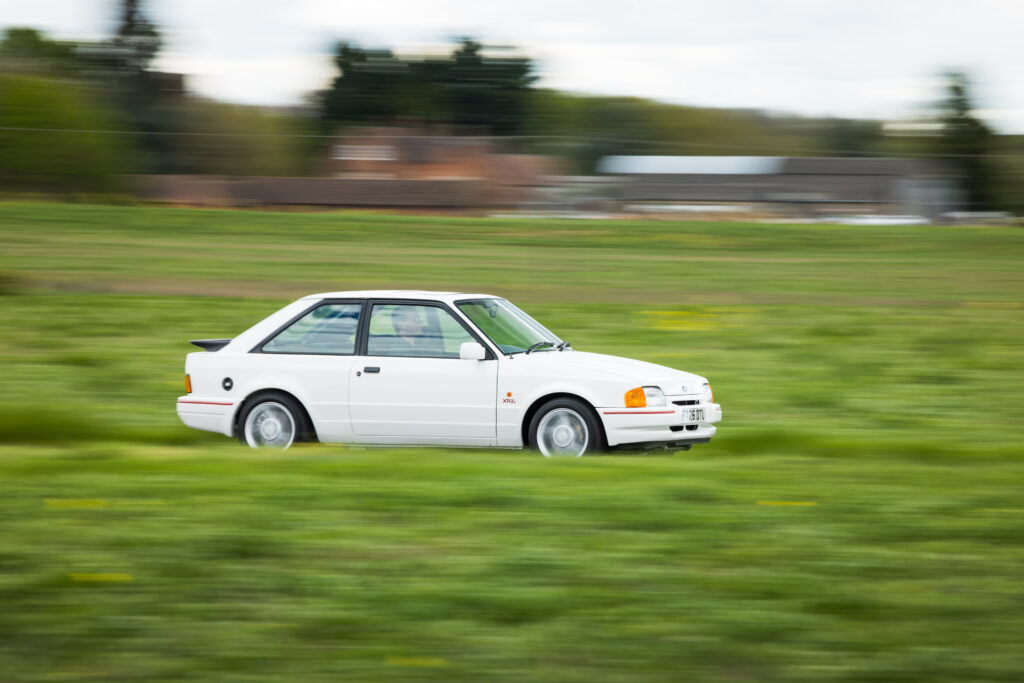
The build began with a standard 1982 donor car in Diamond White with Rosso Red inserts. Predictably, the original bodyshell required a total restoration to eradicate severe corrosion.
The biggest technical challenge on the fabrication side was the completely rusted factory sunroof aperture.
Because there are no high-quality replacement roof skins available in the aftermarket, Tolman had to engineer an in-house solution by designing a bespoke, laser-cut jig and forming tool.
This precision tooling allowed technicians to accurately recreate the exact sunroof aperture and finished edges from a non-sunroof donor skin.
Once fresh steel was welded into place across the body, massive amounts of contemporary underseal and cavity wax were injected into the box sections, representing a critical upgrade over original factory specifications to ensure the car can handle real-world, all-weather driving.
Under the bonnet
The factory 1597cc CVH engine was notorious for its harshness, noise, and misaligned delivery when pushed.
While it would have been significantly faster and cheaper to swap in a modern crate motor, Tolman stuck to its ethos of preserving the car’s mechanical soul by retaining the original block and executing a clever hybrid strategy.
The team mated the original bottom end to a 16-valve Zetec cylinder head, which was supported by upgraded pistons, rods, and a modified RS1600i cam cover.
The engine now runs on a modern, full electronic engine management system, but the ECU and wiring are completely hidden inside the original, period-correct engine bay components to maintain a factory appearance.
On the dyno, the re-engineered unit recorded 150bhp at the wheels, which represents a 50% increase over the original factory 105PS, while driving through a bespoke, stainless-steel 4-2-1 collector and exhaust system mated back to the original five-speed manual gearbox.
Chassis
The original XR3i setup was frequently criticised for being underwhelming in the corners, so Tolman re-engineered the chassis by raiding Ford’s own historic motorsport parts bin and blending it with modern damping technology.
The front suspension uses components from the rare, track-focused RS1600i homologation special, paired with modern Bilstein dampers and a bespoke front anti-roll bar to sharpen steering turn-in and feel within the limits of Ford’s original architecture.
To accommodate better braking performance without ruining the classic look, Tolman engineered custom 15-inch alloy wheels that visually mimic the iconic 14-inch “Dog Leg” wheels down to the factory casting marks.
The larger diameter allows the workshop to package upgraded AP discs up front, convert the rear drums to discs, and wrap them in modern Michelin PE4 rubber while maintaining the standard ride height.
Other subtle, non-invasive upgrades include LED headlights, stainless-steel brake lines, and modern security tracking systems to ensure the car is far safer from unwanted attention than it was in period.
While the Daytona cloth trim and heated windscreen remain familiar to original owners, the cabin has been updated with a modern Blaupunkt DAB radio. Tolman’s XR3i commission, which will be followed by three more one-off 1980s restomods this year, underlines a massive commercial shift where the market for modern classics has matured far beyond simple preservation.
Why it Matters
Who doesn’t love a classic.
The business case though? Well, customers are increasingly demanding that classic vehicles look completely stock but handle, start, and stop like a modern car.
Achieved through advanced diagnostic integration, complex engine hybridisation, and precision metal fabrication, mastering these high-level restoration techniques represents an incredibly lucrative avenue for forward-thinking independent workshops looking to future-proof their businesses.