

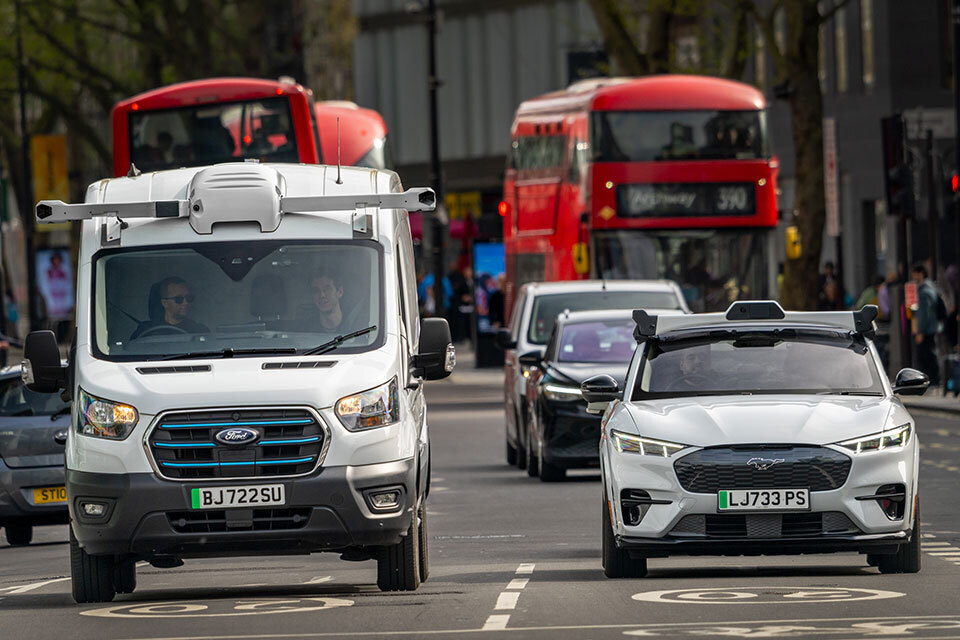
The Department for Transport has officially opened applications for operators to deploy commercial, passenger-carrying self-driving services across the UK starting later this year.
This legislative milestone marks the first time operators can legally offer autonomous, commercial transport models, such as ‘robotaxis’, to the general public.
Backed by major technology firms including Wayve, Waymo, and Uber, the automated passenger services market is projected to be worth some £3.7 billion annually in Britain by 2040.
Watch: Hella Gutmann ADAS investment pays off for Harrogate garage
While policymakers and tech firms celebrate economic growth and the potential reduction of human-error collisions, the independent repair sector must look at the immediate technical realities of maintaining these advanced vehicle platforms.
The fleet maintenance shift
The introduction of commercial autonomous operations signals a rapid acceleration in the transition from traditional, individually owned vehicles to highly used corporate fleets.
Autonomous fleet assets cannot afford unscheduled downtime, meaning they demand rigorous, predictable, and highly specialised preventative maintenance programs.
Related: IGA highlights growing importance of ADAS calibration
For forward-thinking independent workshop owners, this commercial rollout outlines a clear roadmap for future business models, highlighting a critical pivot away from standard retail work toward lucrative B2B fleet service contracts.
The ADAS calibration Burden
On a technical level, these self-driving vehicles rely entirely on complex networks of physical AI, lidar, radar, and camera arrays to safely navigate busy urban streets.
This sensor-heavy architecture fundamentally changes the scope of everyday mechanical repairs, such as tracking adjustments or suspension component replacements.
Related: Why the £1,172 daily downtime figure is your best tool for securing fleet retainers
When an autonomous or semi-autonomous vehicle undergoes a standard steering geometry correction, the subsequent advanced driver-assistance systems (ADAS) calibration becomes a safety-critical operation where even a single millimetre of sensor misalignment could compromise vehicle safety.
Mastering these high-level diagnostic processes and investing in advanced digital alignment rigs is no longer an optional specialist service; it is rapidly becoming the baseline technical requirement for any workshop wanting to remain relevant.
Cybersecurity and Right to Repair
The pilot framework explicitly highlights that all autonomous platforms will face rigorous approval checks and strict safety assessments to protect vehicle tech against cyber and security threats.
As manufacturers and developers implement tighter vehicle network lockouts to safeguard self-driving software, the independent aftermarket’s right to access repair and maintenance data will face its toughest challenge yet.
Ensuring technicians and apprentices have the legal framework and secure digital credentials to access these locked-down systems will be vital if the independent sector is to compete in the multi-billion-pound fleet maintenance arena.
Why it Matters
While transport ministers and Silicon Valley tech firms look at autonomous mobility through the lens of passenger accessibility and macroeconomics, independent workshops must look at it as an impending disruption to localised light commercial vehicle (LCV) and passenger car service models.
A fleet operating on an autonomous blueprint operates 24/7, radically compressing standard component lifecycles. Traditional consumables like service-grade brake friction, steering linkages, and fleet-spec tyres will face accelerated wear curves.
Independent garages that secure local tier-two subcontractor status for these operators stand to benefit from a highly predictable, high-volume parts turn that counteracts traditional seasonal retail dips.
The critical operational threat is not the mechanical repair itself, but the digital handoff. If a vehicle’s primary camera array is shifted even a fraction of a degree during a routine front-end component replacement, the vehicle’s spatial mapping software will drop a critical fault code, dead-lining the asset.