

The Department for Transport (DfT) has opened a major consultation aimed at closing a longstanding legal loophole around in-use vehicle emissions in the UK.
If passed, the proposals will create strict legal obligations for vehicle emissions systems to operate to their original build standard throughout a vehicle’s entire operational life, bringing significant implications for workshop liability, customer communication, and aftermarket parts fitting.
The current regulatory gap
Under current domestic legislation, Regulation 61A of the Road Vehicles (Construction and Use) Regulations 1986 only enforces ongoing compliance up to Euro 4 for light-duty vehicles and Euro V for heavy-duty applications. Consequently, no statutory mechanism exists under Construction and Use rules requiring motorists to maintain the functional integrity of emissions hardware on modern Euro 5, Euro 6, or Euro VI vehicles once they are on the road.
The Department for Transport points to roadside remote-sensing data showing that fewer than one in ten passenger cars in UK cities comply with official nitrogen oxide limits, while nearly two-thirds of Euro 5 and Euro 6 diesels produce more than three times their allowable thresholds.
Officials attribute much of this excess pollution to neglected maintenance and deliberate tampering.
Proposed legal changes and unlimited fines
To close the enforcement gap, the government intends to update Regulation 61A using sections 42, 75, and 76 of the Road Traffic Act 1988, which govern the use of non-compliant vehicles, unlawful alterations, and the supply or fitting of unsuitable parts.
Convictions in the magistrates’ court under these sections carry penalties ranging from £1,000 to unlimited fines.
Why it Matters
For repairers, the proposed framework refuses to distinguish between excess emissions resulting from deferred maintenance and those caused by deliberate modifications, nor will it differentiate between physical hardware changes and engine control unit software remapping.
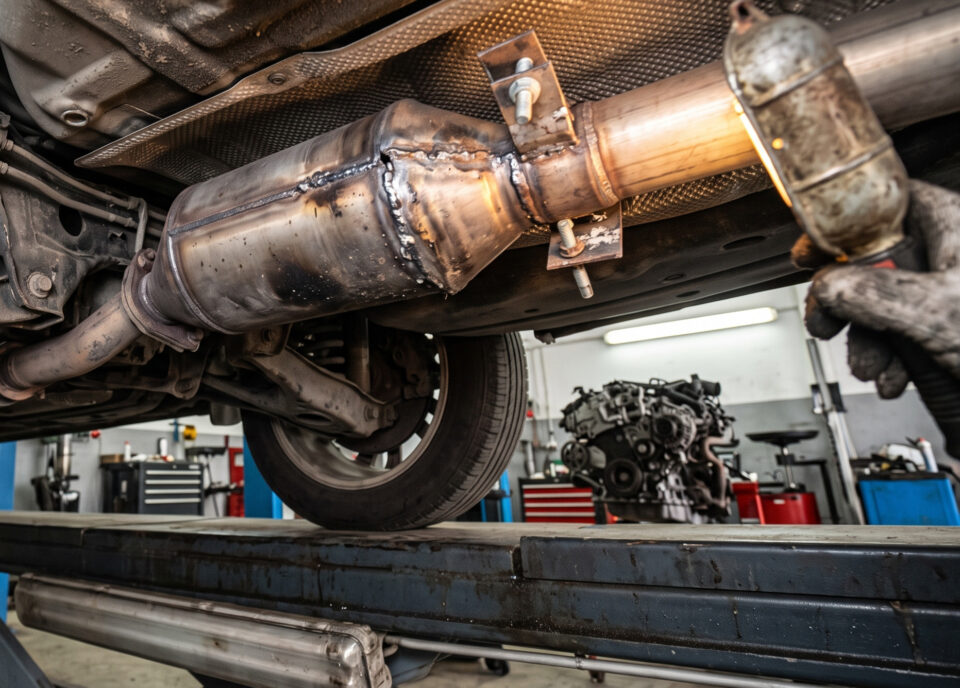
The Department for Transport has explicitly defined the removal or gutting of diesel and petrol particulate filters, the removal of catalytic converters, selective catalytic reduction bypasses, and the blanking or disabling of exhaust gas recirculation systems as unlawful practices.
DPF deletes
Enforcement will focus heavily upstream, empowering the DVSA Market Surveillance Unit to target commercial operations offering delete software or unapproved bypass hardware.
Fitting certified, type-approved aftermarket components remains entirely lawful, though installing non-compliant alternatives or bypass pipes exposes garages directly to prosecution.
The revised scope is also set to encompass two- and three-wheel vehicles alongside cars, vans, and commercial fleets.
Ministers anticipate passing the legislation in summer 2027, followed by a six-month transition window before active roadside and workshop enforcement begins.
The consultation, titled In-use emissions of road vehicles: regulating environmental impacts, remains open for industry responses until 11:59pm on 6 September 2026.
Have your say: How often do you see emissions-deleted vehicles coming into your workshop, and will tougher legislation finally clamp down on ‘cowboy’ operators?

1 comment
Also don’t for get about class 1 & 2 if the fee of £29.65 in 2010 had gone up each year with inflation it would now be worth £49.35 . All our costs have increased over the last 16 years since we opened in 2010 but the MOT fee has remained static how has this been allowed to happen and why are we always left behind no other business would accept this so why should we.
Reply