

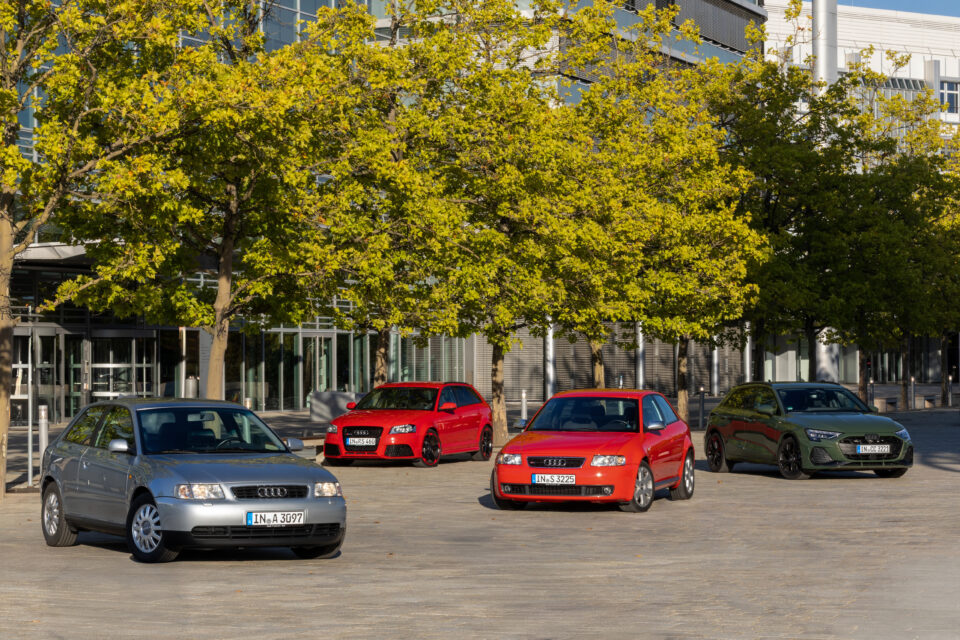
Audi is popping the champagne to mark 30 years and over six million units of the A3.
The manufacturer’s glossy press release talks up “defining the premium compact class,” interior ergonomics, and clean design lines.
For independent workshops, however, the A3 tells a very different story.
Since it first rolled onto UK roads in 1996, the A3 has been a fixture on workshop ramps.
Over four distinct generations, this single nameplate has mirrored the entire technological transformation of modern vehicle repair, taking workshops from mechanical simplicity and vacuum lines to gateway firewalls, high-voltage battery packs, and radar calibrations.
Here is what three decades of the Audi A3 have actually taught technicians on the workshop floor.
First Generation Audi A3 (8L: 1996–2003)
When the 8L arrived sharing Volkswagen’s PQ34 platform with the Mk4 Golf, it introduced mainstream technicians to modern transverse all-wheel drive via the first-generation Haldex multi-plate clutch system.
It taught a generation of apprentices that routine driveline maintenance extended beyond standard differential fluid:
The 20-valve turbocharged petrol engine introduced technicians to complex crankcase ventilation (PCV) systems, secondary air injection quirks, and the infamous oil pick-up strainer sludge that starved turbochargers if low-grade lubricants were used.
Neglected 20,000-mile fluid and 40,000-mile filter changes quickly turned into expensive pre-charge pump burnouts, a harsh lesson in preventative maintenance.
Structurally simple, mechanically forgiving, and largely diagnostic-scanner optional for basic mechanical work.
Second Generation Audi A3 (8P: 2003–2013):
The 8P generation marked the automotive industry’s shift toward direct injection, downsized forced induction, and automated manuals.
It was a massive revenue driver for workshops, but also a steep learning curve.
The arrival of early TFSI petrol engines brought direct-injection high-pressure fuel pumps, cam follower wear, and significant carbon baking on intake valves, turning walnut blasting into a staple workshop service.
Dual-clutch transmissions entered the mainstream. Workshops had to get comfortable with wet and dry clutch pack replacements, adaptation procedures, and mechatronic unit rebuilds.
The new four-link independent rear suspension delivered superb road handling, but UK road salt ensured the rear alignment eccentric bolts seized permanently inside the bushes, turning standard geometry adjustments into angle-grinder battles.
Third Generation Audi A3 (8V: 2012–2020)
Underpinned by the Volkswagen Group’s modular transverse matrix (MQB), the 8V shifted the repair landscape heavily toward digital integration and lightweight architecture.
The EA888 Gen 3 engine gave technicians a consistent stream of cooling work, courtesy of leaking integrated plastic thermostat housings and water pump assemblies failing well before their time.
Forward-facing radar units and windscreen-mounted cameras became standard fare rather than luxury options.
A front bumper removal or routine wheel alignment now demanded workshop investment in static and dynamic ADAS calibration equipment.
The A3 Sportback e-tron landed on ramps in 2014, requiring garages to invest in IMI Level 3/4 EV qualifications, insulated tooling, and high-voltage safety lock-out procedures long before full EVs became a common sight.
Fourth Generation Audi A3 (8Y: 2020–Present)
The current A3 generation represents the modern aftermarket battlefield.
Mechanical issues haven’t vanished, but data access and network topology now take centre stage.
Working on the 8Y’s electronic architecture requires passing through VAG’s SFD (Protection of Vehicle Diagnosis) gateway.
Independent garages without manufacturer portal access, Pass-Thru setups, or SERMI-compliant credentials find basic diagnostic resets and control unit coding walled off.
Belt-driven starter generators (BSG), DC/DC converters, and auxiliary 48V lithium-ion batteries require strict safety protocols and multimeters capable of safe testing before touching basic auxiliary drive belts.
Top-spec models like the RS 3 and refreshed S3 now use torque splitters on the rear axle, ditching traditional Haldex setups for dual electronically controlled multi-plate clutch packs that require dedicated adaptation routines.
Garage Matters verdict
Audi can keep the celebratory brochures.
In the real world, the A3’s true legacy is that it served as the masterclass vehicle for the modern technician.
Every evolution of fuel delivery, drivetrain configuration, thermal management, and digital security that technicians have had to learn over the past 30 years usually arrived on the ramp with four rings on the grille.